
Suturing is divided into five steps: needle adjustment, needle suturing, thread pulling, knotting, and thread cutting. We have discussed needle adjustment before. Today, let's talk about the following operations.
Knotting skills under laparoscopy:
1. When tying knots under laparoscopy, surgical knots should be tied.
2. When tying knots, operate the instruments and knots and thread tails on the left and right. The three points should be in a straight line and cannot form a triangle.
3. When tying the first knot, it is strictly forbidden to cross.
4. Follow the arc and toughness of the thread, and do not struggle when tying knots.
5. Both hands should be able to tie knots.
6. When tying the "clip thread tail" under the scope, keep the length of the short thread tail basically unchanged.
7. The concave surface of the separating forceps and the needle holder are opposite to each other for easy winding.
Laparoscopic knotting operation
There are many ways to tie knots under laparoscopy. The following is an example of C-loop or D-loop method:
1. Reserve the length of the knotting coil:
After pulling the thread, use the left-hand curved separation forceps to clamp the suture. Note that the clamping position should be about 4-5cm away from the knotting position. It should not be too long or too short, which will cause the coil to loosen or the length to be insufficient when tying the knot.
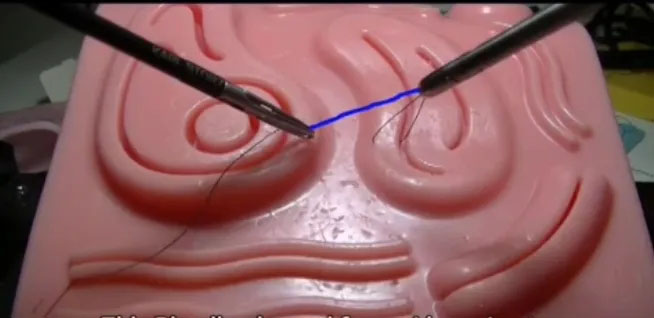
2. Use the tip of the forceps to clamp the suture:
When using the curved separation forceps to tie knots, you can use the arc of the curved separation forceps to wind the wire. Therefore, when clamping the suture, you should use the tip of the forceps to clamp it to ensure that the arc of the forceps body is free for winding.
3. The position of the tip of the forceps is close to the knotting point:
After the left-hand curved separation forceps clamps the correct suture position, it should be as close to the knotting point as possible to ensure that the coil is loose and convenient to form a C ring or D ring. At this time, if the coil does not form a ring, you can use the needle holder to tighten the coil to assist in forming it.
4. Relative winding of the instrument arc:
After determining the suture clamping position, use the needle holder in the right hand to wind the wire. When winding, you can use the arc of the needle holder jaws relative to the arc of the curved separation forceps jaws, so that the needle holder jaws are pulled out from the middle of the arc of the curved separation forceps jaws, so as to avoid the situation where the wire cannot be wound. At this time, pay attention to the closing of the instrument jaws when winding.
When winding, pay attention to the winding direction to avoid continuous winding in the same direction to form a false knot.
5. Clamp the thread tail:
After winding the thread, open the jaws of the needle holder to find the thread tail. Note that the left-hand curved separation forceps should follow the right-hand needle holder to move during the search to avoid the coil being too tight and causing the needle holder to fail to catch the thread tail.
In addition, when clamping the thread tail, pay attention to using the needle holder jaws to pick up the thread tail and then clamp the suture to avoid damage to the clamped tissue.
6. Pull the thread:
After clamping the thread tail, pull the thread with both hands in opposite directions at the same time to tighten the knot, except when tying a slip knot.